

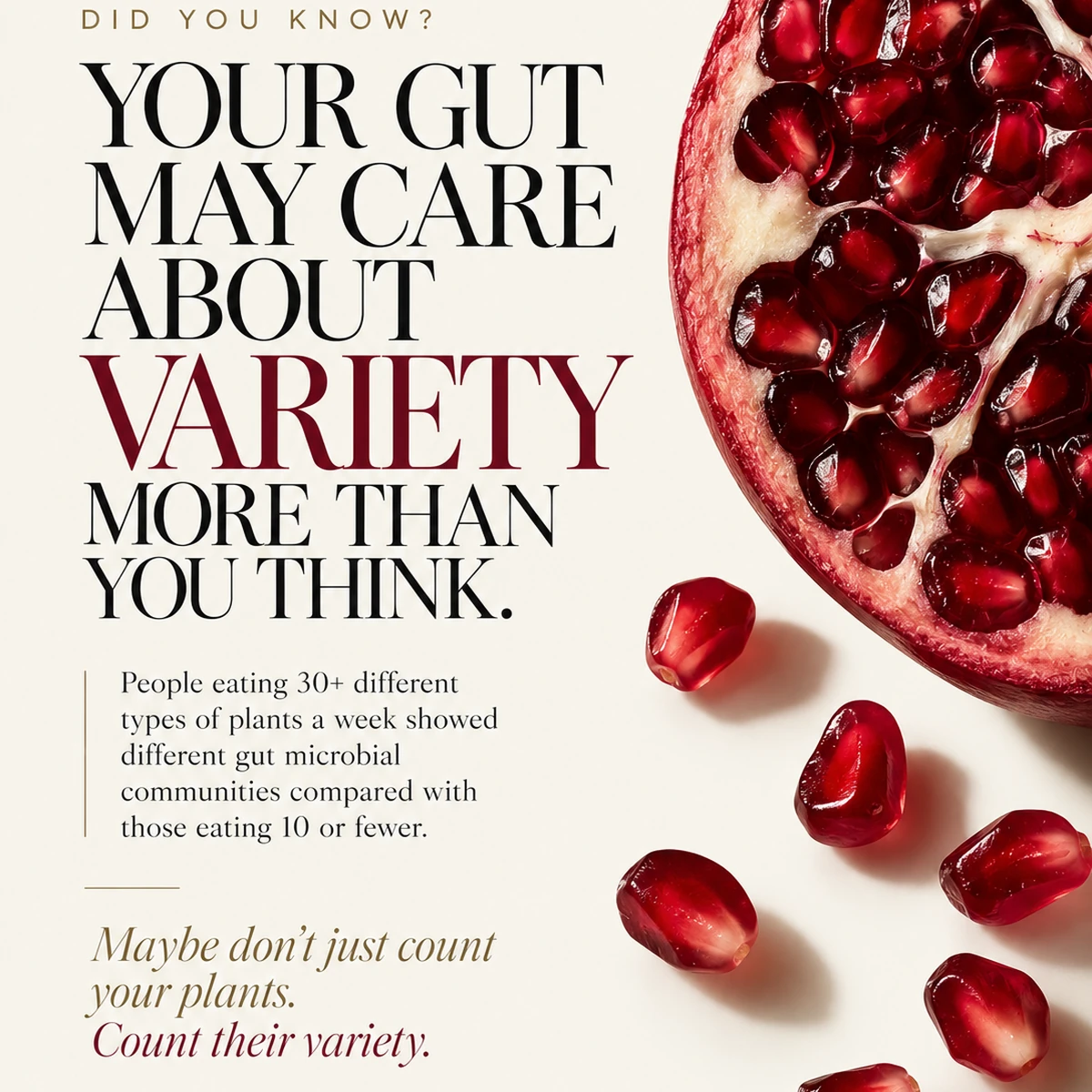
GOOD GUT WEDNESDAY · 02
The Nourishment Edit
We often talk about eating more plants.
But there may be another question worth asking:
How many different plants are you eating?
One of the most fascinating findings to emerge from the American Gut Project — a large citizen-science study involving thousands of participants — was an association between the diversity of plants people ate and differences in their gut microbial communities.
And one comparison in particular captured attention.
Researchers compared people who reported eating more than 30 different types of plants per week with those eating 10 or fewer.
Their gut microbiomes were different.
But before we turn “30 plants” into another nutrition rule, the science deserves a closer look.
Where did the 30-plants idea come from?
In 2018, researchers published findings from the American Gut Project, one of the largest open human microbiome research projects of its time.
Rather than looking only at whether participants identified as vegan, vegetarian or omnivorous, researchers also asked a much more interesting question: in an average week, how many different types of plants do you eat?
This is where last week’s Good Gut Wednesday left off — after looking at why your gut isn’t just home to bacteria, it’s worth asking what we can actually do to support that ecosystem.
When they compared participants at the two extremes — those reporting more than 30 different plant types per week and those reporting 10 or fewer — they found differences in the relative abundance of particular gut microbes.
Several putative short-chain-fatty-acid fermenters were associated with the group reporting more than 30 plants.
Researchers also found differences in certain metabolites and reported a lower abundance of some antibiotic-resistance genes in the higher-plant-diversity group.
That is fascinating.
But it does not mean that 30 is a magic number.
30 isn’t a prescription
This distinction matters.
The American Gut Project was largely observational. Researchers identified associations between people’s reported diets and their microbiomes.
It therefore cannot tell us that eating your 30th plant suddenly transforms your gut microbiome — or that someone eating 29 varieties is somehow doing worse than someone eating 31.
Nor does it prove that plant diversity alone caused the differences observed.
Lifestyle, geography, overall dietary pattern and numerous other factors can influence the gut microbiome.
So rather than treating 30 plants a week as another nutritional target to obsess over, perhaps the more useful lesson is simpler:
Diversity matters.
Why might variety make sense biologically?
“Fibre” is often spoken about as though it were one nutrient.
It isn’t.
Dietary fibres are an extraordinarily diverse collection of carbohydrates with different chemical structures and physical properties. Different fibres can be accessed and fermented differently by different members of the gut microbiota.
And plants bring considerably more than fibre.
They contain different combinations of resistant starches, polyphenols and other phytochemicals — meaning that an apple, chickpea, oat, walnut and broccoli floret don’t present exactly the same nutritional environment to our gut microbes.
Current microbiome research supports the broader idea that diet can shape the composition and function of the gut microbiome, while also showing that individual responses can vary substantially.
So variety may matter because variety provides something that simply eating the same plant foods repeatedly cannot: a broader range of substrates for a broader microbial ecosystem.
What actually counts as a plant?
This is where the idea becomes surprisingly achievable.
When we say plant diversity, don’t think only about vegetables. Think:
Vegetables. Fruits. Beans. Lentils. Chickpeas. Whole grains. Nuts. Seeds. Herbs. Spices.
Your morning oats count. So do the walnuts sprinkled over them. The chia seeds. The blueberries. The cinnamon.
The lentils at lunch. The coriander scattered on top. The sesame seeds with dinner.
Plant diversity doesn’t necessarily require enormous portions of 30 different foods. It is about introducing variety across the week.
Think diversity, not perfection
There is a temptation in nutrition to turn every interesting scientific finding into a rule.
Ten thousand steps. Eight glasses of water. Thirty plants.
But microbiome science is far more complex than a checklist.
Researchers are still working to understand what constitutes a “healthy” microbiome, how different dietary fibres influence different microbial communities and why two people can respond differently to the same food.
Recent scientific reviews emphasise both the powerful relationship between diet and the gut microbiome and the considerable individual variability and unanswered questions that remain.
That uncertainty isn’t disappointing.
It’s what makes this field so interesting.
A little experiment for your own kitchen
Don’t worry about reaching 30 this week. Instead, simply notice.
Open your refrigerator. Look inside your pantry. Think about what you ate over the past seven days. And ask:
How much variety is actually there?
If breakfast is always oats and banana, perhaps tomorrow it becomes oats, banana, flaxseed and cinnamon.
If you always buy one type of lentil, try another. Add an unfamiliar vegetable to your basket. Use herbs generously. Keep several nuts and seeds rather than just one.
Not because 30 is a magical destination.
But because when it comes to plants, perhaps one of the most interesting things we can give our microbial ecosystem is diversity.
So this week’s Good Gut Wednesday question is wonderfully simple:
Don’t just count how many plants you eat. Notice how many different ones you eat.
Research & Further Reading
McDonald D, Hyde E, Debelius JW, et al. (2018).
American Gut: an Open Platform for Citizen Science Microbiome Research.
mSystems, 3(3), e00031-18.
DOI: 10.1128/mSystems.00031-18
View the original study
Ross FC, Patangia D, Grimaud G, et al. (2024).
The interplay between diet and the gut microbiome: implications for health and disease.
Nature Reviews Microbiology, 22, 671–686.
DOI: 10.1038/s41579-024-01068-4
View the peer-reviewed review
Delzenne NM, Bindels LB, Neyrinck AM, et al. (2025).
The gut microbiome and dietary fibres: implications in obesity, cardiometabolic diseases and cancer.
Nature Reviews Microbiology, 23, 225–238.
DOI: 10.1038/s41579-024-01108-z
View the peer-reviewed review
Deehan EC, Mocanu V, Madsen KL. (2024).
Effects of dietary fibre on metabolic health and obesity.
Nature Reviews Gastroenterology & Hepatology, 21, 301–318.
DOI: 10.1038/s41575-023-00891-z
View the peer-reviewed review
The Nourishment Edit is Lynn’s exploration of food, nourishment and the science behind how we eat. Our articles are for educational purposes and are not intended as medical advice.
Researched and edited by Lynn Glenda Pinto

3 thoughts on “Does Your Gut Care About Variety?”
Comments are closed.