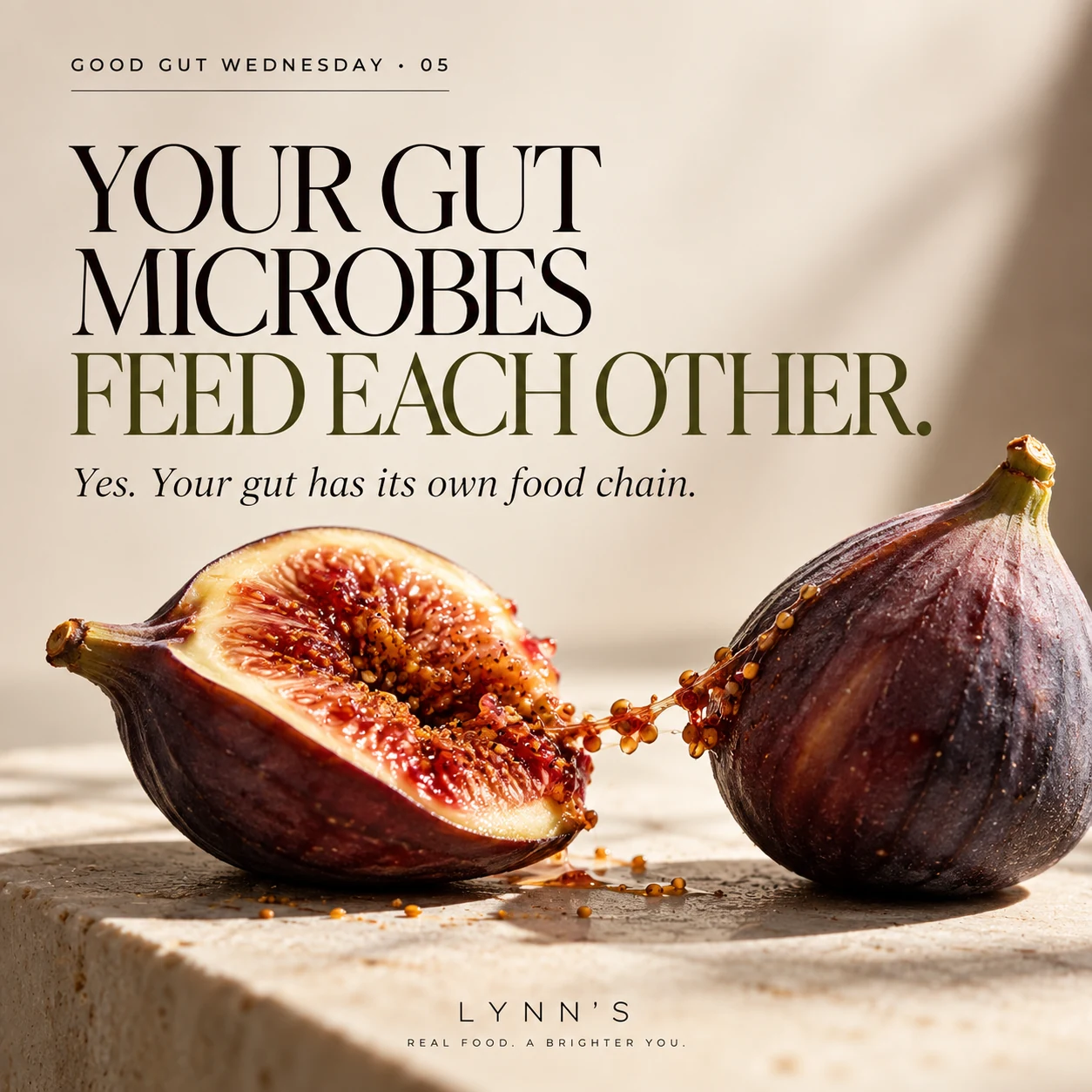
GOOD GUT WEDNESDAY · 05
The Nourishment Edit
Imagine an ecosystem.
One organism consumes something.
It transforms it.
Something else uses what it leaves behind.
Another organism may transform that again.
It sounds like something happening in a forest.
But versions of this are happening inside your gut.
Your gut microbes can feed each other.
Scientists call this microbial cross-feeding — and it helps explain why the gut microbiome is much more interesting than a collection of individual bacterial species.
Your microbiome isn’t a list
Gut-health conversations often focus on individual microorganisms.
Do I have enough of this bacterium?
Is that bacterium good or bad?
But microbial communities don’t exist as isolated entries on a laboratory report.
They live together.
They compete for resources.
They alter their environment.
They interact.
And importantly, compounds produced by one microorganism can sometimes become substrates for another.
The gut microbiome is therefore better understood not simply as a list of microorganisms, but as an interconnected microbial ecosystem.
Researchers studying short-chain fatty-acid production increasingly consider these microbial interactions because the production of metabolites such as acetate, propionate and butyrate can involve complex metabolic relationships between organisms.
What exactly is cross-feeding?
At its simplest:
one organism produces something that another organism can use.
Imagine a fermentable carbohydrate reaching the colon.
One microbial species may possess enzymes that allow it to begin breaking that substrate down.
That process can release smaller molecules or fermentation products.
But those compounds don’t necessarily represent the end of the story.
Another microorganism may be capable of using them.
And what that organism subsequently produces may become relevant to another organism — or eventually to us.
This transfer and utilisation of substrates and metabolites between microorganisms is one form of microbial cross-feeding.
Put simply:
one microbe’s output can become another microbe’s input.
A microbial chain reaction
This means the relationship between food and our microbiome does not always look like:
Food → one microbe → one metabolite
Sometimes it can look more like:
Dietary substrate → Microbe A → intermediate metabolite → Microbe B → another metabolite
And sometimes that second metabolite is one we have already encountered in Good Gut Wednesday:
butyrate.
One fascinating example: Bifidobacterium and Faecalibacterium
Researchers have demonstrated cross-feeding between members of the genera Bifidobacterium and Faecalibacterium.
A particularly useful example comes from research involving Bifidobacterium adolescentis and Faecalibacterium prausnitzii.
Bifidobacteria can ferment certain carbohydrates and produce compounds including acetate and lactate.
Some butyrate-producing microorganisms can then utilise metabolites generated by other microbes.
In a 2015 study, researchers demonstrated enhanced butyrate formation through cross-feeding between Bifidobacterium adolescentis and Faecalibacterium prausnitzii.
Acetate utilisation played an important role in this interaction.
So instead of imagining:
fibre → butyrate
the metabolic pathway may sometimes be better represented as something closer to:
dietary substrate → one microbe → acetate or another intermediate → another microbe → butyrate
That is a much more interesting biological story.
And it demonstrates why looking at individual bacterial species in isolation can miss part of what a microbial community is actually doing.
Lactate can become part of the story too
Lactate is another microbial fermentation product that can participate in cross-feeding.
Certain gut microorganisms can produce lactate, while other organisms are capable of consuming it.
This matters because lactate utilisation can feed into pathways that produce other metabolites, including butyrate in particular microbial relationships.
Research examining interactions between bifidobacteria and lactate-utilising organisms has demonstrated that lactate generated by one microorganism can become a substrate for another.
Again:
one microbe’s metabolic output becomes another microbe’s fuel.
Not every microbe needs to do everything
This is one of the most fascinating characteristics of microbial ecosystems.
An individual microorganism doesn’t necessarily need all the biological machinery required to transform a complex dietary substrate from beginning to end.
Different organisms can perform different parts of the process.
Some microorganisms are particularly capable of breaking down complex carbohydrates.
Others can use smaller molecules released during that degradation.
Still others can consume fermentation products produced by neighbouring organisms.
In ecological terms, the community contains organisms occupying different metabolic niches.
That means some functions of the microbiome begin to make more sense when we look at the community collectively, rather than treating every microorganism as an independent unit.
And this brings us back to food
This is where our previous Good Gut Wednesday conversations begin to connect.
In Good Gut Wednesday · 02, we explored research linking greater plant diversity with differences in the gut microbial community.
In Good Gut Wednesday · 03, we looked at how certain dietary fibres reach the colon and can be fermented by gut microorganisms into compounds including short-chain fatty acids.
In Good Gut Wednesday · 04, we explored resistant starch — starch that can resist digestion in the small intestine and become available to microorganisms farther along the digestive tract.
Cross-feeding adds another layer.
A dietary substrate may be consumed by one organism.
That organism can produce metabolites.
Those metabolites can then become substrates for another organism.
The relationship between food and the microbiome can therefore involve networks of microbial metabolism, rather than a simple one-food-one-bacterium relationship.
Does this mean we should “feed the good bacteria”?
This is where popular gut-health language can become too simplistic.
You’ve probably encountered phrases such as:
“Feed your good bacteria.”
There is a biological idea underneath this.
What we eat influences which substrates reach our intestinal microorganisms, and those substrates can influence microbial metabolism.
But an ecosystem is much more complicated than feeding one supposedly beneficial species.
A substrate consumed by one organism can alter the environment for others.
A metabolite produced by one species can become fuel for another.
Microorganisms can compete.
They can cooperate.
They can exchange metabolites.
And the outcome depends partly on the microbial community that was present in the first place.
This is one reason microbiome science increasingly looks beyond simply asking:
“Which bacteria are there?”
Researchers are also interested in:
“What are they doing?”
and:
“What are they doing together?”
Food doesn’t enter an empty tube
This may be the most useful mental model.
When components of food reach the colon, they aren’t entering an empty digestive pipe.
They’re entering an ecosystem.
An ecosystem populated by microorganisms with different enzymes, different metabolic capabilities and different ecological relationships.
And those organisms interact.
A component of your dinner may be consumed by one microorganism.
What that microorganism produces may become useful to another.
That organism may transform it again.
And some of the metabolites generated through these networks can eventually interact with our own intestinal cells and physiology.
So sometimes the biological story can look something like:
Food → microbe → microbe → metabolite → us.
Not every substrate follows this exact pathway.
Not every microbial community behaves identically.
And different people can harbour substantially different microbial communities.
But cross-feeding demonstrates why the microbiome should be thought of as a living metabolic network, not merely a census of bacteria.
Your microbiome is an ecosystem
Perhaps this is the larger lesson.
The gut microbiome isn’t simply a collection of microorganisms sharing the same address.
It is a community.
Its members can compete.
They can alter their shared environment.
They can exchange metabolic products.
And sometimes:
your gut microbes feed each other.
So perhaps instead of asking only:
“Which gut bacteria are good?”
a more interesting question is:
“What is this microbial community capable of doing together?”
That question takes us much closer to the extraordinary complexity of the ecosystem living inside us.
Scientific Evidence
Rios-Covian D, Gueimonde M, Duncan SH, Flint HJ, de los Reyes-Gavilán CG. (2015).
Enhanced butyrate formation by cross-feeding between Faecalibacterium prausnitzii and Bifidobacterium adolescentis.
FEMS Microbiology Letters, 362(21), fnv176.
DOI: 10.1093/femsle/fnv176
Mukhopadhya I, Louis P. (2025).
Gut microbiota-derived short-chain fatty acids and their role in human health and disease.
Nature Reviews Microbiology, 23, 635–651.
DOI: 10.1038/s41579-025-01183-w
The Nourishment Edit is Lynn’s exploration of food, nourishment and the science behind how we eat. Our articles are for educational purposes and are not intended as medical advice.
Researched and edited by
Lynn Glenda Pinto
Founder, Lynn’s