

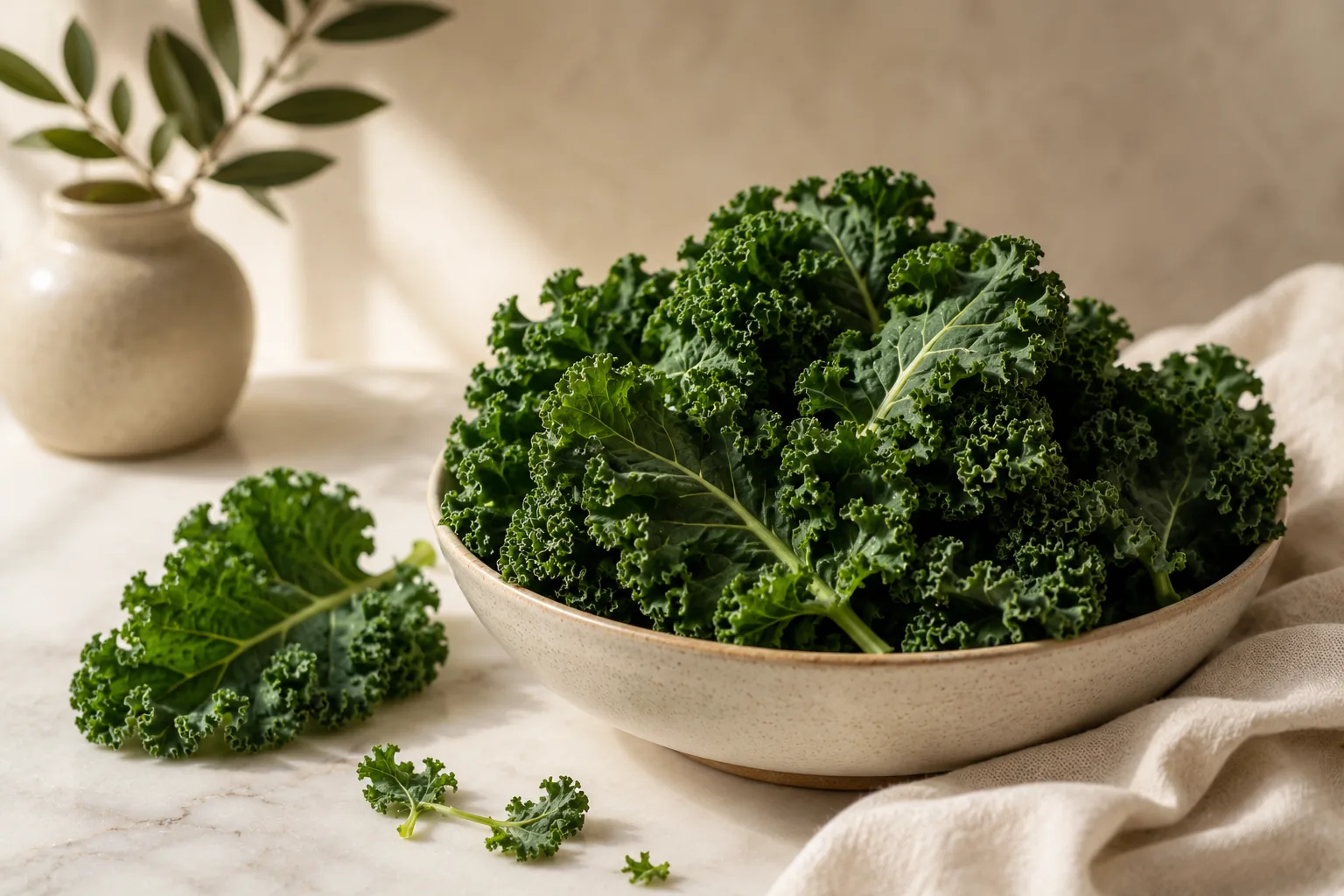
Kale has been called a superfood so often that the word has almost lost its meaning. But forget the label for a moment. What makes kale genuinely interesting is that some of its potential health benefits have actually been put to the test in human clinical studies.
Kale belongs to the cruciferous vegetable family and naturally provides fibre, carotenoids such as lutein and beta-carotene, vitamins, minerals, polyphenols and glucosinolates. Rather than looking for one magical compound, however, it is worth looking at what happens when people actually eat kale.
Kale and Cholesterol
One interesting human study followed 32 men with high cholesterol who consumed 150 mL of kale juice every day for 12 weeks.
At the end of the study, researchers reported that LDL cholesterol had fallen by 10%, while HDL cholesterol increased by 27%. The ratio of HDL to LDL cholesterol also improved significantly.
Those are interesting numbers, but there is an important caveat: this was a relatively small study and did not include a placebo control group. So it gives us a promising signal rather than proof that kale alone will lower someone’s cholesterol.
What About Blood Sugar?
This is where the research gets particularly interesting.
In a randomised, double-blind, placebo-controlled crossover trial, 42 adults consumed either a placebo or food containing 7 g or 14 g of kale alongside a high-carbohydrate meal.
Both kale-containing meals produced a significantly smaller rise in post-meal blood glucose than the placebo.
In other words, researchers weren’t simply measuring what nutrients kale contains. They were observing how consuming kale affected the body’s response to a meal.
And Those Famous Antioxidants?
Kale is particularly well known for carotenoids, including lutein and beta-carotene. But having a nutrient in a food doesn’t automatically mean our bodies can absorb it.
Researchers therefore did something clever: they grew kale containing specially labelled forms of these carotenoids, fed it to human volunteers and then tracked the compounds in their blood.
Both labelled lutein and beta-carotene appeared in the participants’ plasma, demonstrating that these compounds from kale were absorbed by the human body.
Lutein is especially interesting because it is concentrated in the macula of the eye, where it forms part of the macular pigment. This is one reason dark leafy greens are frequently studied in relation to eye nutrition.
More Recent Research: Kale and Metabolic Health
A more recent 12-week randomised, blinded, placebo-controlled clinical trial studied 30 people with type 2 diabetes.
The intervention provided freeze-dried kale powder incorporated into snack bars. Compared with the control group, researchers reported significant improvements in HbA1c, insulin resistance, body weight and calorie intake.
There is an important detail here: the amount of kale used was substantial — approximately 341 g of fresh kale per day according to the study methodology. The trial was also small, with only 30 participants.
So this isn’t evidence that eating a few kale leaves will treat diabetes. It is, however, another intriguing piece of human research suggesting that kale deserves further investigation.
So, Is Kale Really a “Superfood”?
Perhaps we don’t need the word at all.
No single food prevents disease, and clinical trials on kale are still relatively limited. What we do have is human research exploring effects on blood lipids, post-meal glucose, carotenoid absorption and metabolic health.
Add that to kale’s naturally nutrient-dense whole-food profile, and there is already plenty to appreciate — without needing to turn it into a miracle food.
Sometimes the most interesting foods aren’t the ones making the biggest promises. They’re the ones that quietly give scientists something worth investigating.
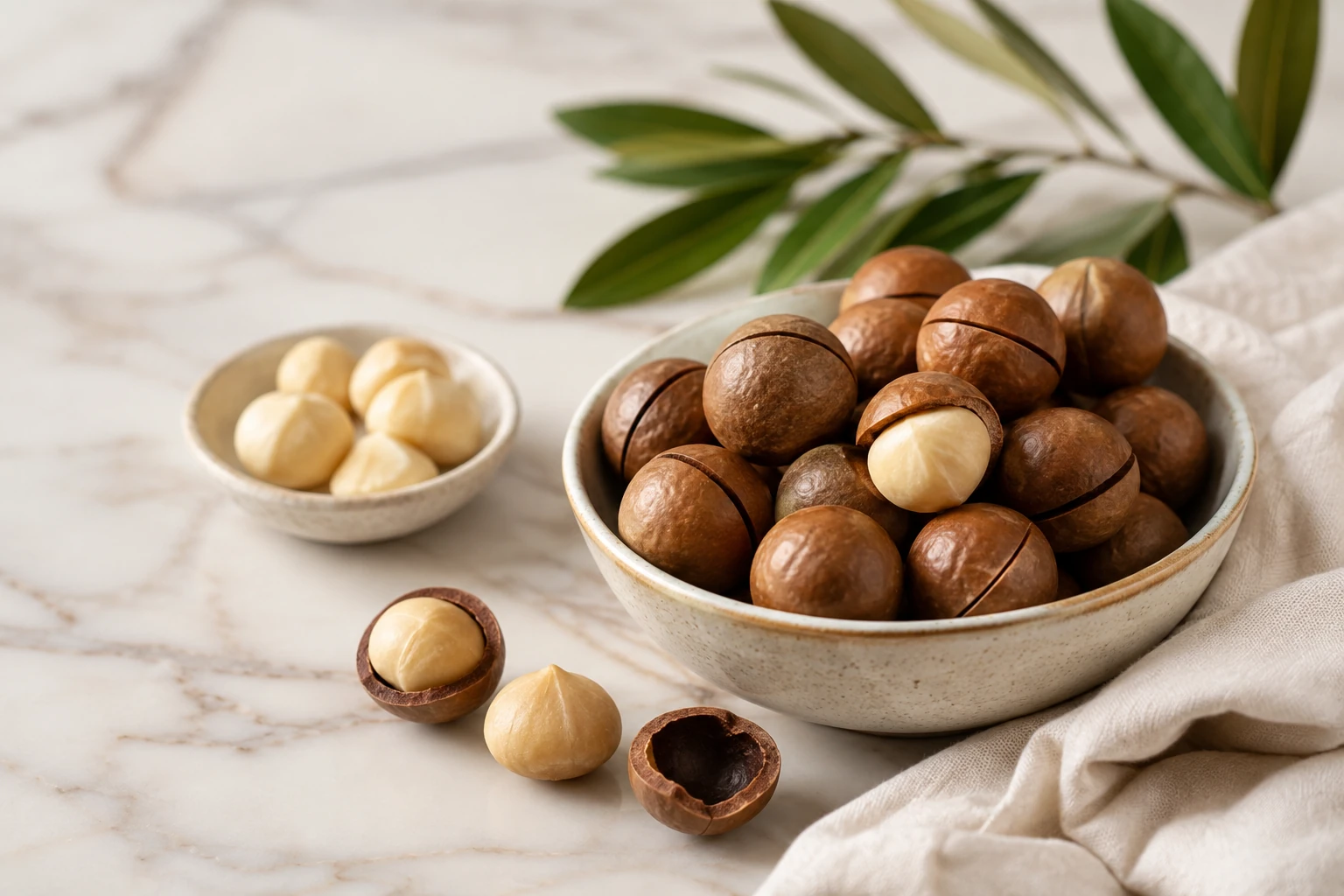
It’s a pattern that shows up again and again once you start looking at the research directly — much the same story we found when we looked at macadamia nuts and their omega-7 fat content: real, if modest, human evidence tends to be far more interesting than a marketing label.
If whole-leaf kale sounds worth trying beyond a salad, our Signature Kale Crisps — whole leaves, slow-crafted with olive oil, nutritional yeast, garlic and onion — are a fitting place to start.
Research & Further Reading
Kim SY, Yoon S, Kwon SM, Park KS, Lee-Kim YC. (2008).
Kale juice improves coronary artery disease risk factors in hypercholesterolemic men.
Biomedical and Environmental Sciences, 21(2), 91–97.
DOI: 10.1016/S0895-3988(08)60012-4
View the peer-reviewed study on PubMed
Kondo S, Suzuki A, Kurokawa M, Hasumi K. (2016).
Intake of kale suppresses postprandial increases in plasma glucose: A randomized, double-blind, placebo-controlled, crossover study.
Biomedical Reports, 5(5), 553–558.
DOI: 10.3892/br.2016.767
View the peer-reviewed study on PubMed
Novotny JA, Kurilich AC, Britz SJ, Clevidence BA. (2005).
Plasma appearance of labeled beta-carotene, lutein, and retinol in humans after consumption of isotopically labeled kale.
Journal of Lipid Research, 46(9), 1896–1903.
DOI: 10.1194/jlr.M400504-JLR200
View the peer-reviewed study on PubMed
Jeppesen PB, Dorner A, Yue Y, et al. (2024).
Beneficial Effects of a Freeze-Dried Kale Bar on Type 2 Diabetes Patients: A Randomized, Double-Blinded, Placebo-Controlled Clinical Trial.
Nutrients, 16(21), 3641.
DOI: 10.3390/nu16213641
View the peer-reviewed clinical trial on PubMed
Researched and edited by Lynn Glenda Pinto
One thought on “Kale Health Benefits: What Does the Research Actually Say?”
Comments are closed.